

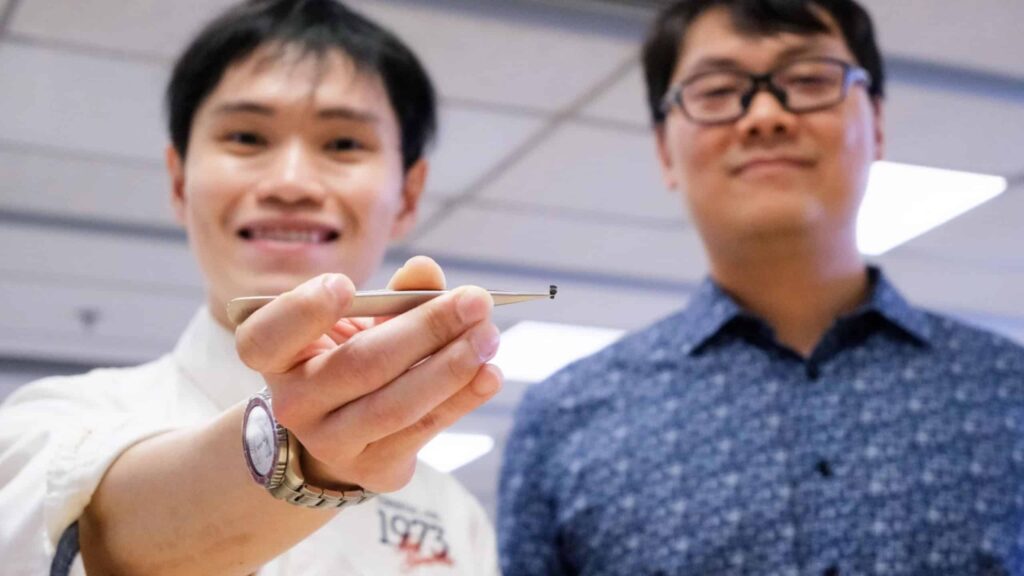
Researchers at Nanyang Technological University in Singapore have created a seed-sized surgical robot capable of performing five different functions: moving, cutting tissue, delivering medicines, grasping and storing samples, as well as generating heat remotely. The device only measures 4,4 mm and is controlled by weak magnetic fields.
The idea is to pave the way for less invasive medical procedures, in which small robots could navigate narrow, irregular regions of the body to perform localized tasks, reducing the need for large incisions or bulky surgical instruments.
Five functions in a microscopic body
The big advance is not just the size, but the combination of functions. Many magnetic microrobots can move or perform a simple task. The NTU prototype was designed to switch between different action modes in less than a second.
In laboratory tests, the robot was able to cut biological tissue, release particles that simulate medicines, hold samples, store them and generate localized heating when exposed to a high-frequency alternating magnetic field.
This heating is particularly interesting because it connects to research into magnetic hyperthermia, an approach studied for attacking unwanted cells, such as tumor cells, through controlled heat. Still, in this case, we are talking about an experimental demonstration — not a ready-made clinical treatment.
How is it controlled
The robot uses flexible magnetic materials, including silicones common in soft robotics, such as PDMS and Ecoflex. These materials are mixed with magnetic microparticles, allowing different regions of the robot to respond in specific ways to the applied field.
The secret lies in the central magnetic module, which can be magnetized, demagnetized and remagnetized in different directions. Each orientation activates a different function. This solves a common limitation in microrobots: at such small scales, the magnetic field tends to move the entire device, making independent control of specific tools difficult.
The project also adds a sixth type of movement: rolling around its own axis. According to the researchers, this helps the robot to position itself better in narrow, soft and irregular environments, such as those found inside the human body.
What's still missing
The research was published in the journal Advanced Materials and is still in the laboratory phase. The tests involved tissue models including chicken liver and gelatin materials that simulate soft tissue. The team also evaluated the materials' biocompatibility with human skin cells in the laboratory, with more than 99% of the cells remaining viable under the conditions tested.
The next challenge is enormous: integrating the robot with more realistic imaging systems, sensors and artificial organ models. After that, there would still be pre-clinical studies, safety validation, animal testing and, eventually, clinical trials.
Even far from hospitals, the concept shows where minimally invasive surgery can go: robots that are increasingly smaller, more versatile and capable of doing more than simply moving.
Continue lendo
Manned electric plane flies with solid-state battery for the first time
Um avião elétrico experimental da Helios Horizon realizou voos tripulados com baterias de estado sólido, tecnologia que pode…

This 'beginner' electric motorcycle costs $38,000, and the bill is difficult to pay
A Novus One quer misturar bicicleta elétrica, scooter e moto leve em um único veículo urbano. O problema…

Lightweight mesh intercom helmet connects up to 15 riders at once
Lumos is a company known for designing bicycle helmets with integrated lighting systems. Its previous models focused primarily on visibility…