

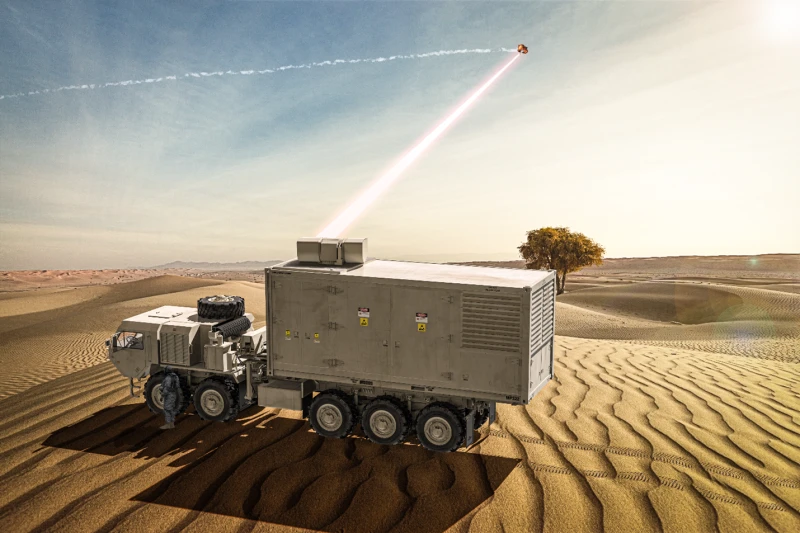
The United States Department of Defense has begun a strategic investment to transform direct-energy warfighting capabilities. With an initial contribution of US$86 million, the government seeks to develop a new laser gun capable of reaching 500 kW of power, aiming to neutralize modern threats such as cruise missiles and swarms of drones.
This initiative is fundamental because the current security scenario requires quick and economically viable responses. Unlike conventional ammunition, the system promises an extremely low cost per shot and a practically unlimited ammunition capacity, making it an essential asset for the air defense modern.
Overcoming Direct Energy Challenges
Historically, beam-based weapons technology has faced significant technical obstacles, such as the need for raw power and the complexity of field engineering. The lower the power, the longer the beam needs to remain fixed on the target, which limits effectiveness against high-speed threats.
To reach 500 kW, engineers need to mitigate the phenomenon of thermal bloom. This effect occurs when the heat from the laser heats the surrounding air, causing the beam to scatter and lose accuracy at greater distances, a challenge that requires advanced optics and cooling solutions.
Logistics engineering and mobility
The project of Joint Laser Weapon Systems requires combining multiple beams of different wavelengths without damaging internal components. The biggest practical challenge, however, lies in integrating all the necessary hardware into a real operational environment.
Currently, a system of this magnitude requires a 40-foot container to house the power supply, cooling system, and sending unit. Current engineering efforts focus on reducing size and weight, ensuring that the military technology can be transported and operated efficiently in different conflict scenarios.
Program phases and industrial partners
The contract, which could reach a ceiling of US$847 million, involves companies such as Lockheed Martin and nLIGHT Defense. The strategy adopted by the government prioritizes rapid prototyping to bypass traditional acquisition processes, accelerating the delivery of operational capabilities to the field.
The development schedule is structured into incremental steps to ensure technical effectiveness:
- Implementation of an initial 150 kW prototype to meet urgent operational demands.
- Progressive scaling for intermediate powers between 300 and 500 kW.
- Final integration of the complete system with a maximum capacity of 500 kW.
Tactical impact on the battlefield
Upon reaching the 500 kW mark, the system can melt and destabilize the structural integrity of moving targets almost instantly. This capability is vital for countering saturation attacks, where the volume of drones seeks to overwhelm conventional defenses.
The speed of response, which occurs at the speed of light, allows the operator to switch between multiple targets with unprecedented agility. This level of operational flexibility is considered a critical component for protecting the territory against emerging high-tech threats.
FAQ
What is the main objective of this project The focus is to neutralize cruise missiles and drone swarms through rapid response and low cost per shot.
The system is now ready for military use No, the project is currently in the prototyping phase, with development structured in stages of increasing power.
What are the biggest technical difficulties highlighted? The project faces challenges with thermal bloom and the need to downsize cooling and power systems to make them mobile.
Also read: The New Cycle of Weight Fluctuation with Obesity Medications.
Source and methodology
This article was prepared based on information published by newatlas.com, on July 17, 2026. See the publicação original: US military commits millions to 500-kW super laser weapon. HTechBD reorganized and contextualized the data for the Brazilian public, without reproducing the source text.
Image: Opt Lasers from Poland no Pexels.
Continue lendo

The New Cycle of Weight Fluctuation with Obesity Medications
Entenda como a interrupção de tratamentos com GLP-1 pode criar um novo padrão de oscilação de peso, desafiando…

Fires in Canada: smoke reaches the USA and affects air quality
Incêndios florestais no Canadá geram plumas de fumaça que cruzam fronteiras, impactando a qualidade do ar em regiões…

US Air Force launches missile with autonomous drone
A Força Aérea dos EUA testou com sucesso o disparo de um míssil a partir de um drone…