

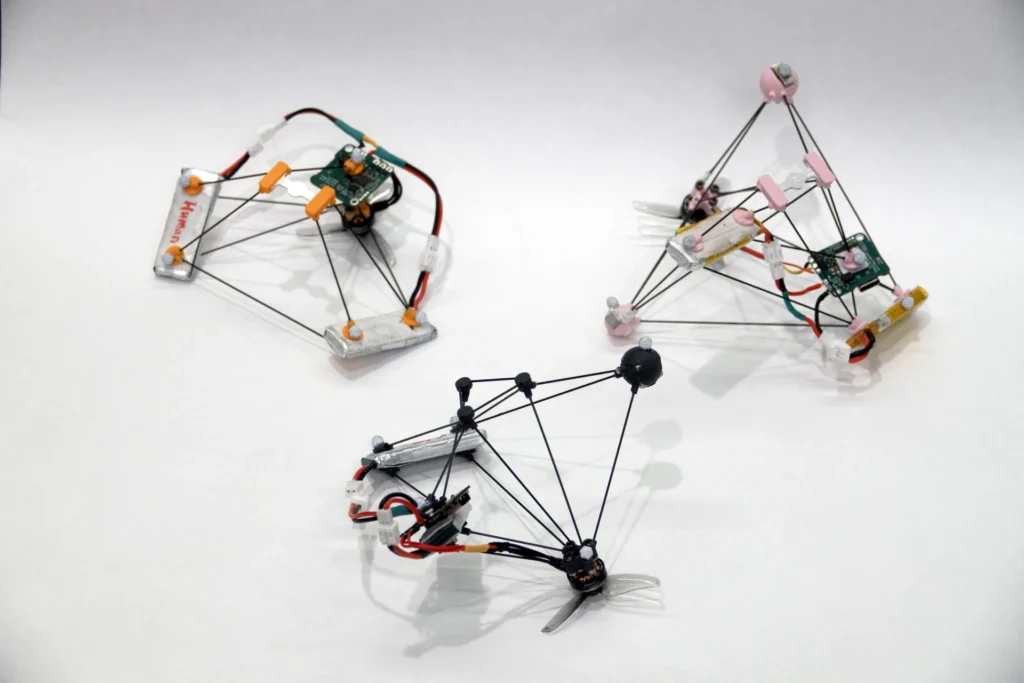
engineers from Northwestern University developed a prototype unmanned aircraft capable of becoming a challenge for the human eye. baptized by Phantom Twist, the device does not require conventional coatings or color camouflage, relying on a technique based on the physics of movement to reduce its visual presence.
This innovation is fundamental for areas where the presence of traditional equipment alters the behavior of animals or people observed. By mitigating visual detection, the project seeks to enable environmental studies and infrastructure inspections with a much lower impact on the local ecosystem.
The physics of movement as camouflage
The central concept of the project lies in the way the biological visual system processes stimuli. Human vision works in a similar way to the exposure time of a camera, accumulating visual signals for a fraction of a second. When the Phantom Twist rotates at high speed, it prevents the brain from identifying sharp details, creating a blurring effect.
Unlike common quadcopters, which have static bodies while only the propellers rotate, this design integrates a single engine where the body and propeller rotate in opposite directions. This configuration eliminates fixed parts, ensuring that no component of the aircraft remains stationary for the observer to focus on. The team used artificial intelligence to simulate around 20,000 possible configurations, refining the weight distribution and position of electronic components.
Optimization via algorithms and metrics
To arrive at the ideal design, the researchers used optimization algorithms that tested the aircraft's performance in 100 real background scenarios. Each simulation was subjected to a perception metric developed specifically to mimic human vision, where the final score determined the success of the concealment. The 500 best-performing versions went through additional rounds of refinement before the physical prototype was built.
The research was officially presented at the Robotics: Science and Systems 2026 conference, held in Sydney. Professor Michael Rubenstein highlights that most occultation attempts in the industry focus on adapting the color of the drone to the environment. Instead, the group decided to design the device around motion perception, a field that has received little scientific attention to date.
History and evolution of aerial occultation
The quest for stealth aircraft is not a new concept in aerospace engineering. The study cites the 1944 project known as Yehudi Light, which used lighting to hide maritime patrol aircraft against the sky. While past methods focused on light, the Phantom Twist focuses entirely on manipulating constant motion.
The project also differs from previous attempts, such as the so-called Boomerang Drone from 2006. At that time, the equipment tried a similar rotation trick, but was unable to reach the speed necessary to exploit the blurring effect, leaving the structure visible. The new model, by rotating up to 25 times per second, can surpass the detailed processing capacity of the human eye.
Current limitations and perspectives
Despite its effectiveness, the drone is far from being completely invisible or undetectable. The engine still generates an audible noise, which can betray its presence even when human vision fails to detect it. Furthermore, support rods and certain structural elements remain partially visible, preventing an effect of absolute concealment in the environment.
The team recognizes that the same mechanism that protects wildlife from human interference can be applied for less transparent purposes. Future iterations of Phantom Twist they can incorporate more transparent materials and quieter propulsion systems to improve overall performance. For now, the prototype serves as a proof of concept for a new form of interaction between robotics and visual biology.
FAQ
- Is the drone really invisible? No, it uses a blurring effect that makes it about 10 times harder to detect than regular drones.
- Why does it spin like that? The constant rotation prevents static parts from being visible to the human eye, creating a faint haze.
- Is noise a problem? Yes, the engine noise is still audible, which limits its total stealth in quiet environments.
- What is the main practical application? Wildlife monitoring and infrastructure inspection without causing escape reactions in animals or people.
Also read: US invests $86 million in new laser weapon technology.
Source and methodology
This article was prepared based on information published by newatlas.com, on July 17, 2026. See the publicação original: Tiny drone hits invisible mode by twisting faster than eye can detect. HTechBD reorganized and contextualized the data for the Brazilian public, without reproducing the source text.
Image: Adika Budiman no Pexels.
Continue lendo

ICML 2026: The Rise of Open Models in AI Research
A edição de 2026 da conferência ICML destaca como a infraestrutura e modelos de IA abertos tornaram-se pilares…
NVIDIA Expands Jetson Thor Line for Robotics and Edge AI
Novos módulos T3000 e T2000 prometem levar a inteligência artificial de ponta e modelos de fundação para robôs…

Humanoid companion robots: Ubtech's bet on the market
A chinesa Ubtech lançou a série U1, robôs projetados para oferecer companhia, mas a eficácia real da tecnologia…